

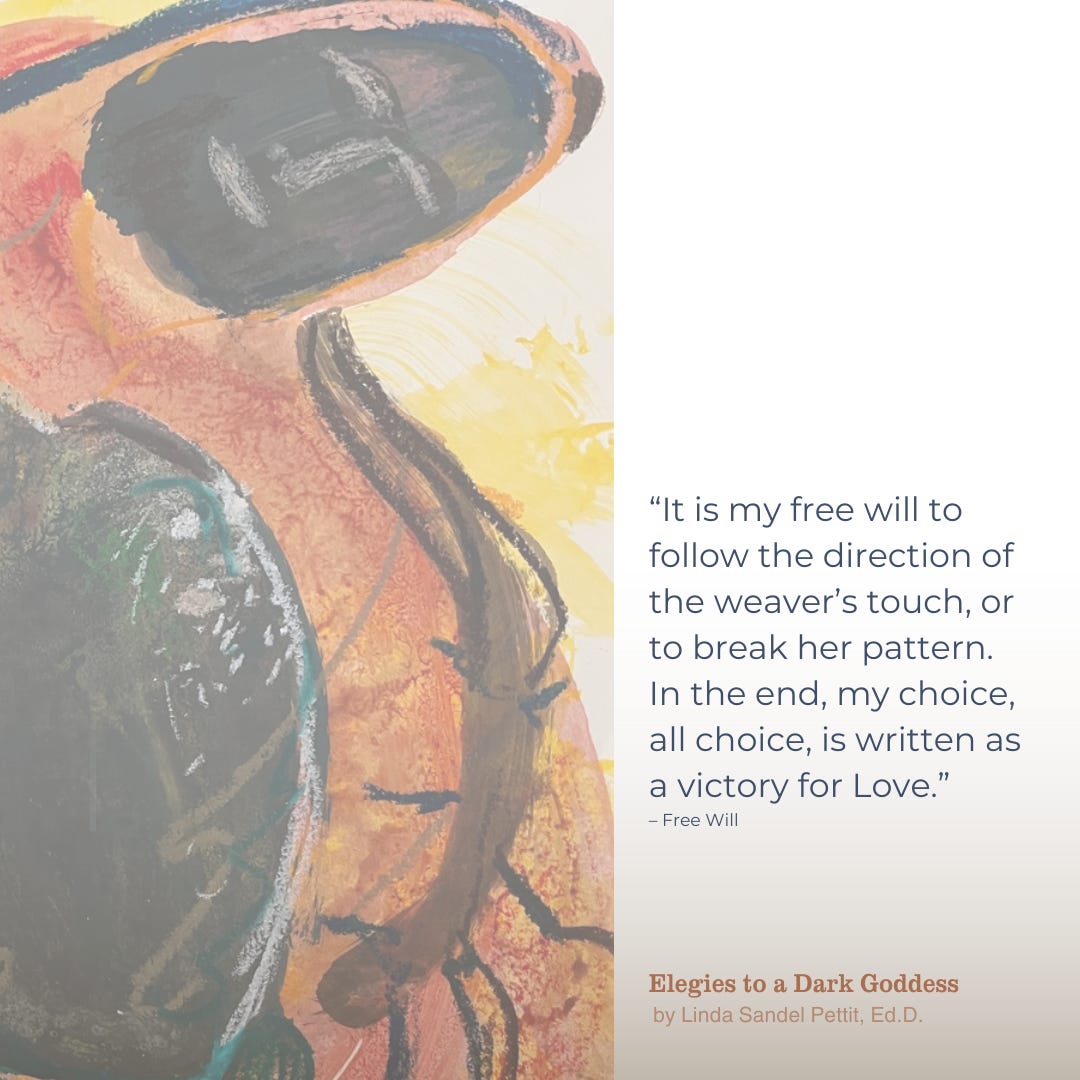
In Elegies to a Dark Goddess, my compact poetic memoir, the elegy, Free Will, is one of my favorites. The words tumbled onto the page from the depths of my soul. After I typed them, I stared in wonder. They were beautiful to me. As was often the case while writing Elegies, poetry gave me a way to express deep understandings and emotions that eluded me in prose.
In the elegy, Initiation, which comes just before Free Will, I describe, in poetic form, what it felt like to have a childhood experience so terrifying it divided life into “before” and “after.” Before, I was carefree, joyful, and well-liked. After, I was anxious, shame-riddled, and felt backwards. At nine years old, I had been sexualized, and grappled with dreams, images, and experiences my child-self could neither understand nor integrate.
My words tried to capture that loss of innocence:
“The abyss evacuated the marrow from your spongy bones and spit you out, an innocent spineless skin, a seeping organ of despair, a pitiful child.”
This was my initiation into a world of innocence shattered—and a portal to a search for meaning, a descent beyond the physical world into the spiritual. The muses of both the Child and the Great Mother guided me.
Free Will arose from a different voice—the Maiden, or adolescent/young adult muse. Its tone is softer, more philosophical. It begins:
“I was written, some say, as the musk of ebony ink on creamy parchment bound in plum-colored leather, pages edged with gold, a book that rests in shafts of sunlight aswirl with dust motes on a shelf heavy with the library of knowledge. In this alchemic tale, I am devoid of free will.”
In these lines, I wrestle with choice, destiny, and co-creation. Is life scripted? Or is it an exquisite dance between me and the Creative Mother? The Elegy answers:
“It is my free will to follow the direction of the weaver’s touch or, to break her pattern. In the end, my choice, all choice, is written as a victory for Love.”
From there, Free Will turns to a second descent—a relationship betrayal in my young adulthood. Another “before” and “after” moment, not unlike the one described in Initiation. Yet my worldview had softened. I was more philosophical, more conscious of the Creative Mother’s ability to use everything “as a victory for Love.”
“After a time that must be sacrificed to such losses, a tug on my thread shuttled a new pattern. I felt the Madonna’s unseen touch and could not but surrender to the confident artist.”
The final stanza is a joyous celebration of divine grace and potential:
“The slender thread of my warp emerged, an exploded star, a black hole, a magnet for light to serve my destiny, a wounded healer.”
I invite you to join me on September 7th for a Salon Launch and conversation about Elegies to a Dark Goddess. My fondest hope is that these poems, which often felt like transmissions from beyond, will inspire fresh reflections on the beauty, richness, and gold to be found in your own life—even in the dark places.
To register for the Salon: https://lindasandelpettit.com/programs-for-transformative-insights/